
Categories
New Blog
Standard chillers force trade-offs in precision and efficiency. A custom design chiller matches exact thermal loads for industrial applications. This system maintains temperatures within ±0.5°F despite process changes. Such precision matters for manufacturing, chemical processing, and HVAC cooling needs. A tailored design eliminates guesswork. It meets significant cooling needs without oversizing. The goal here is to explain the engineering process, key customization options, and real benefits. A custom chiller manufacturer focuses on building these tailored solutions for every cooling challenge.
Custom chillers fit exact cooling needs, so there is no guessing or buying a chiller that is too big.
Engineers check heat loads, temperature limits, and site conditions for each design.
Programmable controllers and remote sensors keep temperatures within ±1°F.
Split-system designs put condensers outside to save indoor space and lower noise.
Backup circuits and self-running operation keep important processes going without stopping.
Choosing the right chiller size cuts energy waste and lowers total cost of ownership.
Oumalchiller uses 100% copper pipes and stainless steel tanks to make it last longer.
A custom design chiller follows a clear engineering path. Each stage builds on the one before it. The process starts with collecting data and ends with a fully integrated unit. A custom chiller manufacturer uses this method for every project.
Engineers start by gathering facts about the application. They ask about equipment use, size, location, safety needs, and voltage supply. Each answer shapes the final design. A chemical plant needs different features than a food processing line.
The heat load sets the foundation. Engineers figure out how much heat the process makes per hour. They also measure the needed flow rate and the target temperature. A low-temperature chiller serves processes below 35°F. Precision matters here. The unit must hold ±0.5°F across the full operating range.
The installation site drives many decisions. An outdoor location needs sump heaters and insulation. An indoor spot may limit the footprint. Hazardous areas require explosion-proof chillers that meet NFPA standards. The cooling fluid also matters. A glycol-water mix stops corrosion. City water may need filtration before use.
Data alone does not build a chiller. Engineers must model how the unit acts under real conditions. They study peak demand and part-load operation. They also pick the right refrigeration cycle.
Processes rarely run at a steady rate. Engineers simulate both peak and variable loads. This step shows how the chiller responds when demand spikes. A variable-frequency drive adjusts compressor speed to match the load. This approach keeps evaporation and condensation temperatures stable. Fixed-speed units cannot match this flexibility.
The closed-loop vapor-compression cycle sits at the heart of every unit. Remote sensors feed temperature data back to the controller. This loop holds the setpoint within ±0.5°F. Condensing temperature directly affects efficiency. A lower condensing temperature cuts compressor power consumption.
Evaporation temperature must stay below the outlet chilled water temperature. Raising it cuts compressor power. Push it too high and cooling capacity drops. Push it too low and the evaporator may freeze.
Engineers weigh several factors when they pick a cycle. The table below compares two common approaches.
|
Factor |
Air-Cooled |
Water-Cooled |
|---|---|---|
|
Energy Efficiency |
Lower, sensitive to ambient temperature |
Higher, stable operation |
|
Environmental Adaptability |
Performance degrades in high summer temperatures |
Less affected by external temperature |
|
System Complexity |
Simple, integrated fan |
Complex, requires cooling tower and pumps |
|
Condensation Temperature |
Higher, increases compressor power |
Lower, improves efficiency |
The final stage brings parts together into one working unit. Engineers match compressors to condensers. They also plan for control and autonomy.
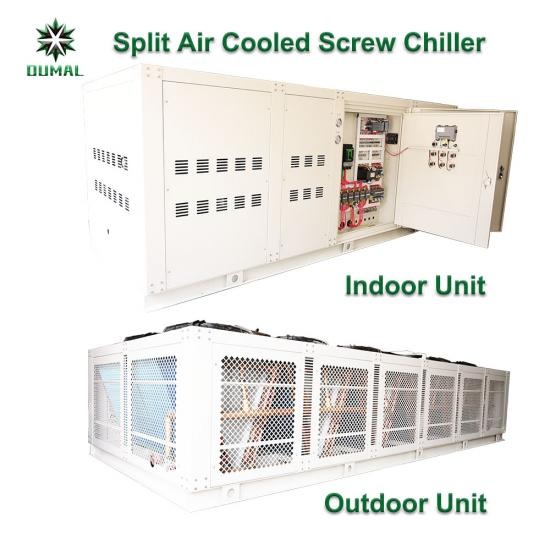
Compressor selection depends on the load profile. A screw compressor handles large capacities well. The condenser type follows the site. An air-cooled chiller works where water is scarce. A water-cooled chiller suits facilities with cooling towers. Engineers often build a Split-System Air Cooled Screw Chiller and Condensing unit for sites with tight indoor space. The condensing section sits outdoors. The evaporator section stays inside. This layout solves many spatial problems. The frame must carry heavy loads across rough ground. A chiller frame must do the same job for thermal loads.
Modern chillers run with very little supervision. A PLC or SCADA system manages the cycle. Remote sensors monitor temperature at the process, not just at the unit. This setup allows true closed-loop control. Autonomous operation takes this idea further. In some designs, chilled water cools the chiller itself. The unit manages its own thermal load without outside help. This feature saves energy and extends component life.
A custom design chiller gives you more than standard cooling equipment. Engineers pick features that fit the exact process. The most flexible areas are capacity and fluid choice, enclosure building, and control systems. Each choice directly affects how well it works and how long it lasts.
The heart of a chiller is its ability to remove heat at the right temperature. Two decisions drive this: the temperature range and the fluid that carries heat away.
Industrial processes run across a wide range. High-temperature chillers serve ranges from 86°F to 203°F. Low-temperature units drop to -31°F. Ultra-low-temperature models reach -184°F. The coolant must match the target range. Water works for standard cooling between 41°F and 86°F. Glycol-water mixtures extend the range below freezing, commonly to -40°F. For extreme cold below -4°F, engineers choose silicone oils, inert fluorinated fluids, or hydrofluoroethers. Fluid compatibility matters as much as temperature. Standard refrigerants include R-410A, R-134a, R-404A, and R-407C. Some processes require dielectric coolants, PAO oils, or deionized water. Custom chillers are built with 100% copper piping and 304 stainless steel tanks.
Correct sizing prevents both shortfall and waste. The most common mistake is picking capacity based on average load instead of peak demand. HVAC air-cooled chiller equipment faces the most stress when outside temperatures rise and cooling loads spike at the same time. An outdoor air-cooled setup loses capacity as outside temperature climbs. Engineers suggest a 10 to 20 percent buffer for stable commercial loads. Processes with big changes need a 20 to 30 percent buffer. Going over 30 percent oversizing causes efficiency and cycling problems. A chiller running at 50 to 70 percent capacity works better than one cycling at 30 percent load. For highly variable loads, multiple smaller units work better than one large unit. Key factors include compressor staging, variable speed capability, minimum evaporator flow, and chilled water volume. A buffer tank keeps temperature steady in systems with fast changes.
The physical build of an air-cooled system must handle the installation environment. Corrosion, weather, and space limits drive material and enclosure choices. Custom design allows adding specific enclosure types for harsh conditions. An outdoor air-cooled setup must handle rain, salt spray, and UV radiation.
Harsh environments need strong materials. High-grade stainless steel type 304 gives excellent corrosion resistance in chemical plants or coastal facilities. Compact footprints allow installation in tight machine rooms. Noise-dampened packages support installation near hospitals or office spaces. Explosion-proof construction meets NFPA standards for hazardous locations.
Split-system designs solve space challenges in existing facilities. The condensing section sits outdoors. The evaporator section stays inside near the process. This setup removes heat rejection from the indoor space, reduces noise, and frees floor area. The outdoor condenser benefits from cooler outside temperatures during summer months. Pipe runs between sections require careful insulation.
Precision in temperature control comes from the feedback loop between sensors and controllers. Modern equipment uses advanced electronics to keep tight tolerances and reduce operator workload.
A fully sensored chiller monitors multiple circuit points. Water in and out temperature sensors, refrigerant suction and discharge sensors, a tank level sensor, ambient air sensors, and a relative humidity sensor provide complete data. A PLC with a touchscreen processes this information and adjusts operation in real time. The control loop compares actual fluid temperature to the setpoint and adjusts compressor speed, expansion valve position, and pump output. This system achieves temperature precision within ±0.5°F. Cloud-based web monitoring allows remote diagnostics. Operators log data, spot problems early, and adjust setpoints from anywhere. Remote sensor loops monitor process temperature rather than chilled water temperature alone. This enables true closed-loop control.
Autonomous control goes beyond simple feedback. Control software continuously optimizes setpoints and executes control actions in the PLC or BMS. The controller adjusts based on real-time data. Variable speed compressor control matches real-time load and avoids energy waste. Integrated controls align the system with cooling towers, pumps, and air handling units to minimize total power consumption. Safeguards ensure stable operation.
A custom design chiller gives you real gains in three areas. These are energy efficiency, reliability, and total cost of ownership. Each benefit comes from the careful engineering we talked about earlier.
A standard chiller often runs below its rated capacity. This mismatch wastes power and makes equipment wear out faster. A custom design chiller fixes this problem at the source.
Oversized chillers turn on and off all day long. Each start and stop wastes energy and wears down the compressor. These units also run poorly at partial loads. A properly sized cooling system avoids these penalties. Custom engineering uses thermal load analysis and precision control optimization to match capacity to real demand. Smart controls for energy optimization and multi-stage setups for different cooling zones cut power use even more. The result is lower energy consumption across the full operating range.
The condenser and compressor must work as a matched pair. A mismatched set forces one part to make up for the other. This raises power consumption and lowers cooling capacity. Engineers pick compressors and condensers together during the design phase. They also tune the refrigerant cycle for the site's ambient conditions. An air-cooled chiller in a hot climate needs a different condenser profile than one in a mild region. This matching process improves energy efficiency and makes components last longer.
Critical processes cannot handle temperature swings. A custom design chiller holds stability that standard units cannot match.
Precision cooling demands tight control. A custom chiller reaches temperature stability of ±0.5°F. This minimizes thermal drift and ensures repeatable manufacturing. Intelligent closed-loop control with PID algorithms constantly adjusts coolant temperature under changing loads. For processes that require high precision, custom chillers with PLC-based control and remote monitoring achieve reliable operation.
Downtime costs money in any industrial setting. A master controller rotates compressors into lead position for even wear. This approach to reliability ensures heavy loads are handled without failure.
The purchase price tells only part of the story. Lifetime costs often dwarf the initial investment.
Custom chillers often incorporate higher efficiency and better build quality. This may lower lifetime total cost of ownership relative to purchase price.
Space constraints often force expensive building modifications. A custom design chiller fits the available footprint without costly renovations. Split-system air-cooled configurations place the condenser outdoors and the evaporator indoors. This frees floor space and reduces indoor noise. Customized engineering tailors physical dimensions to the specific application. This reduces installation time and avoids structural changes.
A custom design chiller gives you better process control, energy savings, and long-term value. Standard units make you accept trade-offs. Tailored systems help you avoid them.
A custom chiller engineering team works step-by-step to match every part to your application. This approach covers hydraulic optimization, automation, and scalable growth. It also ensures reliable performance all year long. The result is lower total cost of ownership and fewer production interruptions. A chiller built around your actual process demands prevents productivity losses during peak conditions. It also supports future expansion without replacing the whole system. For hvac and industrial cooling needs, this precision pays off. Contact a custom chiller manufacturer for a free application assessment. Start the custom design journey today.
Lead times depend on how complex the project is. The manufacturer gives you a timeline during the first consultation. A basic custom unit moves faster than a complex system with multiple circuits. Planning starts after the needs assessment.
A split-system puts the condenser outdoors and the evaporator inside the facility. The Split-System Air Cooled Screw Chiller and Condensing unit removes heat rejection from the building. This frees floor area and reduces indoor noise.
Options range from open-frame designs to full cabinets. High-grade stainless steel resists corrosion in chemical plants. Explosion-proof construction meets NFPA standards for hazardous locations.
A custom design chiller holds temperatures within ±0.5°F of the setpoint. Advanced configurations reach ±0.5°F using remote sensor loops. This precision is achieved through PLC-controlled PID algorithms and variable speed compressors.
Oversized units cycle on and off and waste power. Custom sizing matches capacity to real demand. Engineers optimize the compressor and condenser pair for the site. This eliminates part-load penalties and cuts energy consumption.
A master controller rotates compressors for even wear. The design handles heavy loads without breakdown.
The purchase price accounts for only a portion of lifetime costs. Energy makes up the largest share. A custom chiller lowers total cost through higher efficiency and reduced maintenance.



Friendly Links :
www.dyyseo.com en
en es
es