 en
en es
es
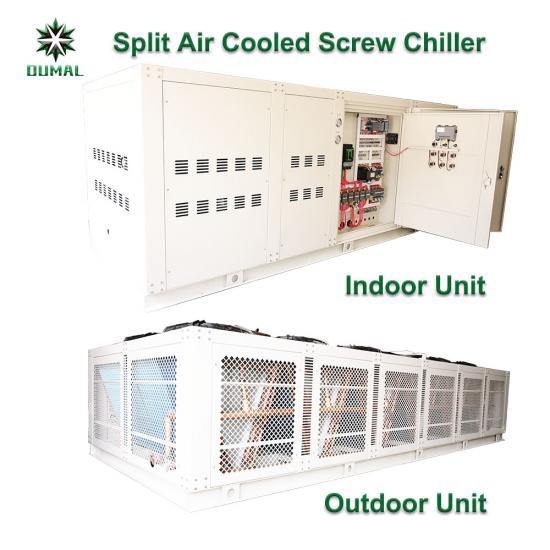
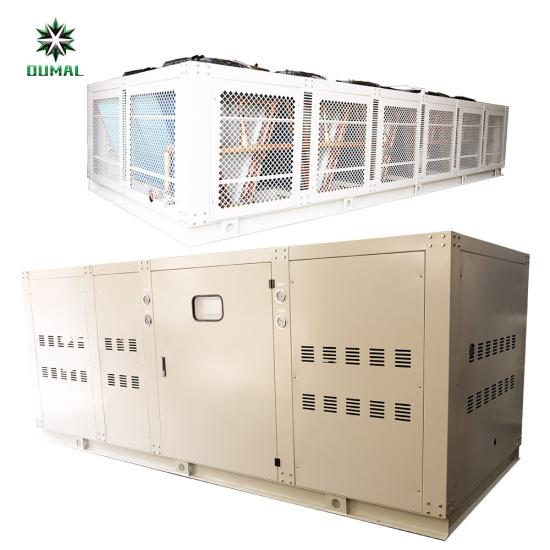
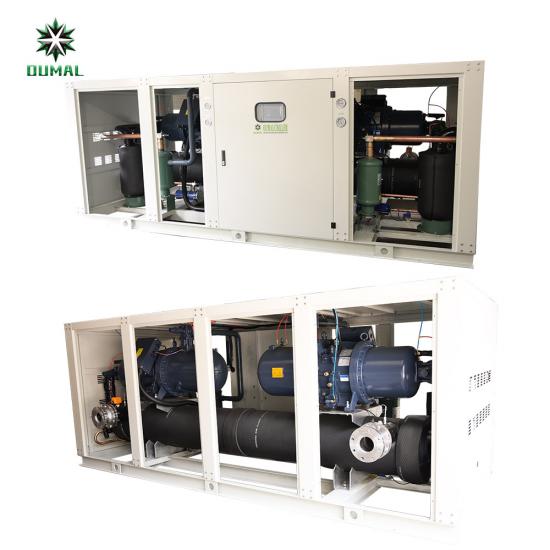
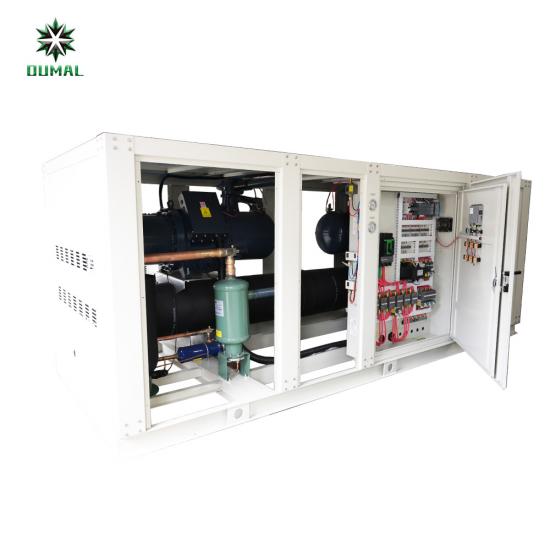
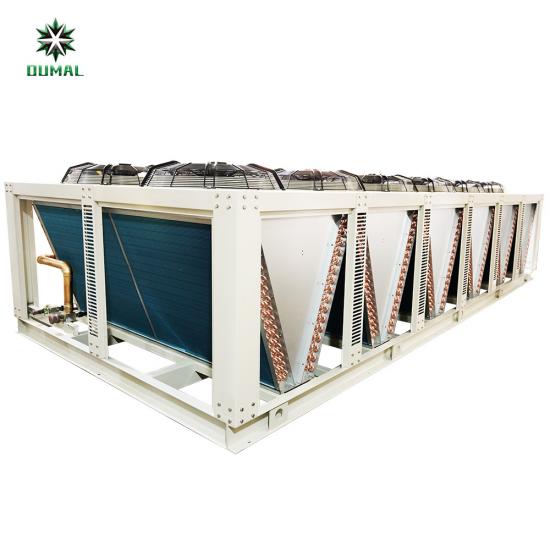
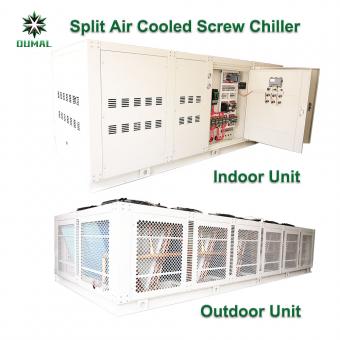
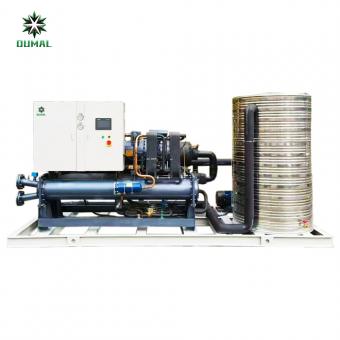

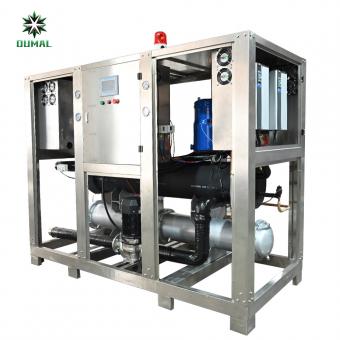
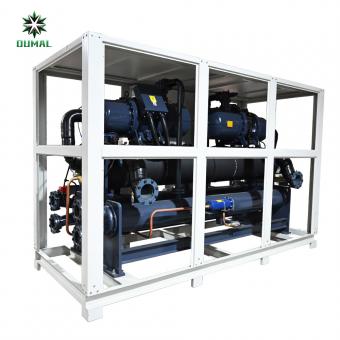
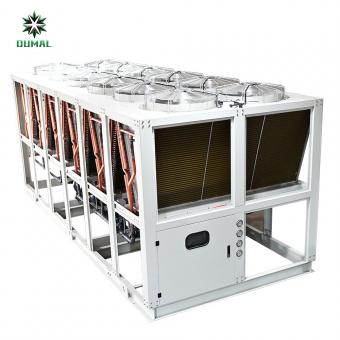
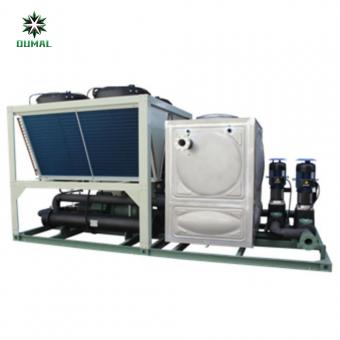
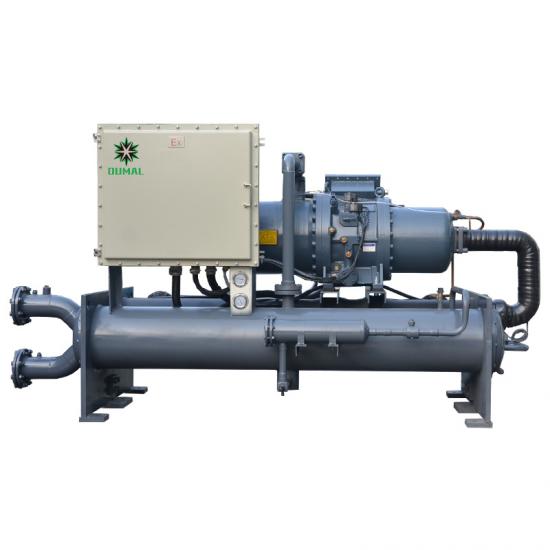
120 Ton Split-System Air Cooled Screw Chiller and Condensing Unit
What is a Split-System Air Cooled Screw Chiller ?
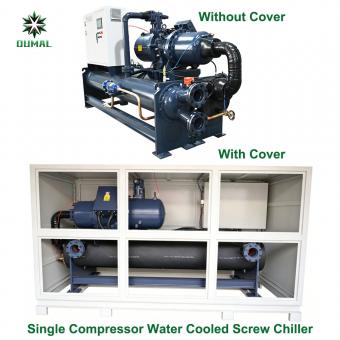
Standard integrated air-cooled chillers house the compressor, condenser cooling fan, evaporator, water tank, and water pump within a single cabinet frame; the unit is shipped and installed as a complete, single assembly.
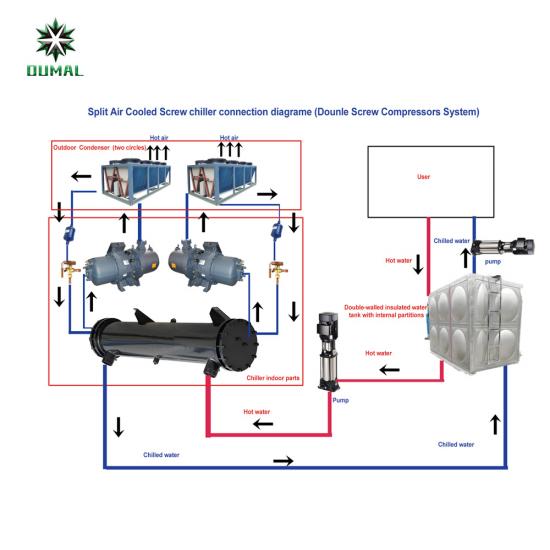
Split-system air-cooled chillers: The unit is separated into two independent components—an indoor main unit and an outdoor condensing unit. These are connected on-site via copper piping for the refrigerant circuit and water piping for the water circuit to form a complete cooling system.
Fundamentally, it remains an air-cooled system that does not require a cooling tower; the difference lies solely in the separated structural configuration.
Two main components:
Indoor unit (located inside the factory or equipment room)
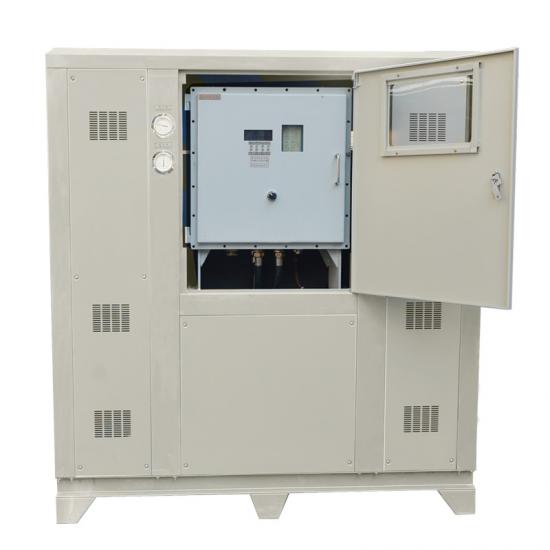
Includes: Evaporator, insulated water tank, circulating water pump, electrical control system, and temperature control module.
Function: Pumps chilled water to production equipment to cool molds, reaction vessels, or the workshop area.
Outdoor unit (mounted on a wall, rooftop, or ground level)
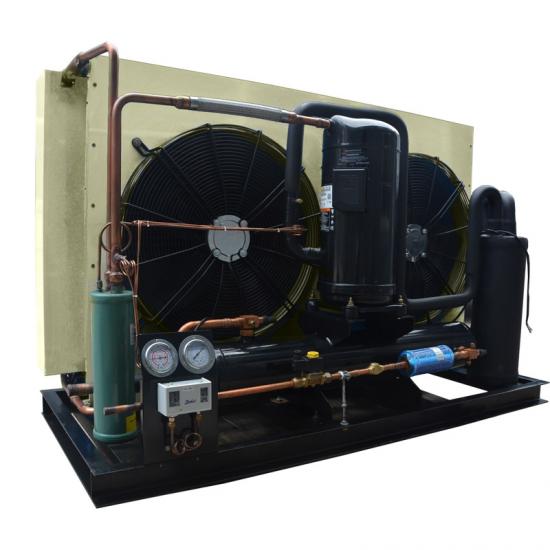
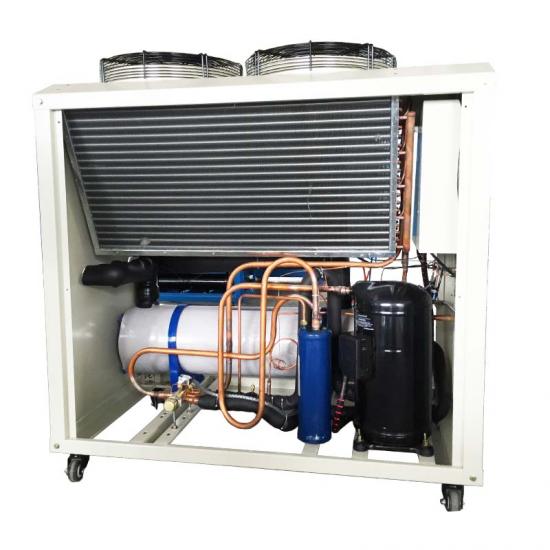
Includes: Screw compressor, finned condenser, and cooling fan.
Function: Compresses refrigerant and dissipates heat into the ambient air; functions similarly to the outdoor unit of a standard air conditioner.
Why produce split-system air-cooled screw chillers?
The split-system air-cooled screw chiller was developed specifically to address the major pain points associated with integrated air-cooled units.
In traditional integrated air-cooled screw chillers, the compressor, condenser fans, evaporator, water tank, and water pump are all housed within a single frame. This creates significant drawbacks regarding transportation, site access, installation, noise levels, heat dissipation, and spatial adaptability. The split-system design separates the unit into two sections: an indoor main unit (containing the evaporator, water tank, water pump, and electrical controls) and an outdoor condensing unit (containing the compressor, finned condenser, and cooling fans). These sections are connected by refrigerant copper piping, effectively resolving common industry challenges.
1. Solves challenges with transporting and installing large units (a critical requirement)
Large-capacity integrated air-cooled screw chillers often have dimensions that exceed standard limits for width and height. Constraints such as truck size limits, narrow site gates, corridors, or basement entrances, as well as load limits on roads and bridges, often prevent the unit from entering the site intact. On-site disassembly and reassembly are frequently required, which carries a high risk of refrigerant leaks, pipeline damage, and warranty issues.
The split-system design divides the unit into two major modules, significantly reducing the volume and weight of each component, allowing for standard truck transport and easy entry through elevators or doorways;
It offers greater flexibility for transport in mountainous regions, overseas exports, and cross-border shipping container loading, avoiding the high "oversized cargo" shipping costs and booking complications associated with fully assembled units.
2. Achieves complete indoor noise reduction and vibration isolation; ideal for noise-sensitive workshops
With integrated units placed inside the workshop, the simultaneous operation of the compressor and multiple cooling fans typically generates noise levels of 75–85 dB. This can disrupt workshop operations, quality control laboratories, pharmaceutical cleanrooms, and adjacent office areas.
By placing all noise and vibration sources in the outdoor unit—leaving only water circulation and electrical control components indoors—noise levels can be kept below 55 dB;
Split-system models are the preferred choice for equipment rooms, cleanrooms, laboratories, hospital facilities, and central air conditioning retrofits in office buildings.
3. Superior heat dissipation with the outdoor unit; more stable cooling in high-temperature environments
With all-in-one units, hot air circulates within the casing; in enclosed factories with poor ventilation, hot air cannot escape, causing condensing pressure to spike, cooling capacity to drop sharply, and frequent high-pressure shutdowns.
Split-system outdoor units can be installed on rooftops, exterior walls, or open ground, allowing hot air to be vented directly outdoors without indoor obstruction;
This offers higher heat dissipation efficiency—and a lower risk of high-temperature shutdowns—in conditions such as hot southern summers, enclosed factories, and poorly ventilated spaces.
4. Highly flexible site layout; not constrained by dedicated equipment room space
All-in-one units require a dedicated, contiguous open area for placement;
With split systems, the indoor unit can be placed anywhere in the workshop or equipment room, while the outdoor unit is positioned nearby (on a wall, roof, or the ground); refrigerant piping can be routed freely up to a dozen meters as needed;
Split systems are the only viable solution for projects involving the renovation of older factories, compact equipment layouts, or a lack of space for a dedicated equipment room.
5. Avoids the risk of freeze damage in winter; distinct advantages for cold northern regions
When all-in-one air-cooled units are shut down in winter, the entire unit—including piping and water tanks—is exposed to the outdoor environment; a power outage can easily cause water pipes and heat exchangers to freeze and crack;
In split systems, the indoor water tank and circulation system are housed in an insulated indoor space, with only the outdoor unit exposed; winter freeze protection is achieved simply by draining the outdoor unit's refrigerant side, eliminating the risk of water-side freezing and making the system highly suitable for northern projects.
6. Easier maintenance and repair; independent troubleshooting
All-in-one units pack components tightly into a single frame, requiring extensive disassembly and relocation to service the compressor or fan;
The split design allows for targeted maintenance on the specific module where a fault occurs, eliminating the need to move the heavy unit as a whole; spare outdoor or indoor modules can be stocked separately, significantly reducing downtime for maintenance and repairs. 7. Retains the inherent advantages of air-cooled models: no cooling towers required
Unlike water-cooled screw chillers, split air-cooled systems eliminate the need for cooling towers, cooling water pumps, circulating water piping, and water treatment equipment, thereby saving on the construction of water basins and water circulation infrastructure.
Ideal for water-scarce regions, island projects, remote construction sites, and temporary production lines; cooling operations can begin without connecting to a municipal water supply, significantly reducing infrastructure costs and construction timelines.
II. Typical customer scenarios suited for custom split-system models
Pharmaceutical GMP cleanrooms, physicochemical laboratories, and precision instrument temperature control (requiring strict noise control and a clean environment)
Renovation of older factories where narrow doorways or small elevators prevent the entry of large, integrated chiller units
High-temperature, enclosed factories in the South where integrated units suffer from poor heat dissipation and frequent high-pressure shutdowns
Northern regions with low winter temperatures, where placing the entire unit outdoors poses a risk of freezing damage to the water circuit
Overseas exports where container loading space is limited; splitting the unit facilitates shipping, customs clearance, and container loading
Rooftops with limited space, requiring outdoor units to be distributed across the area while the indoor chilled-water heat exchange unit is placed inside
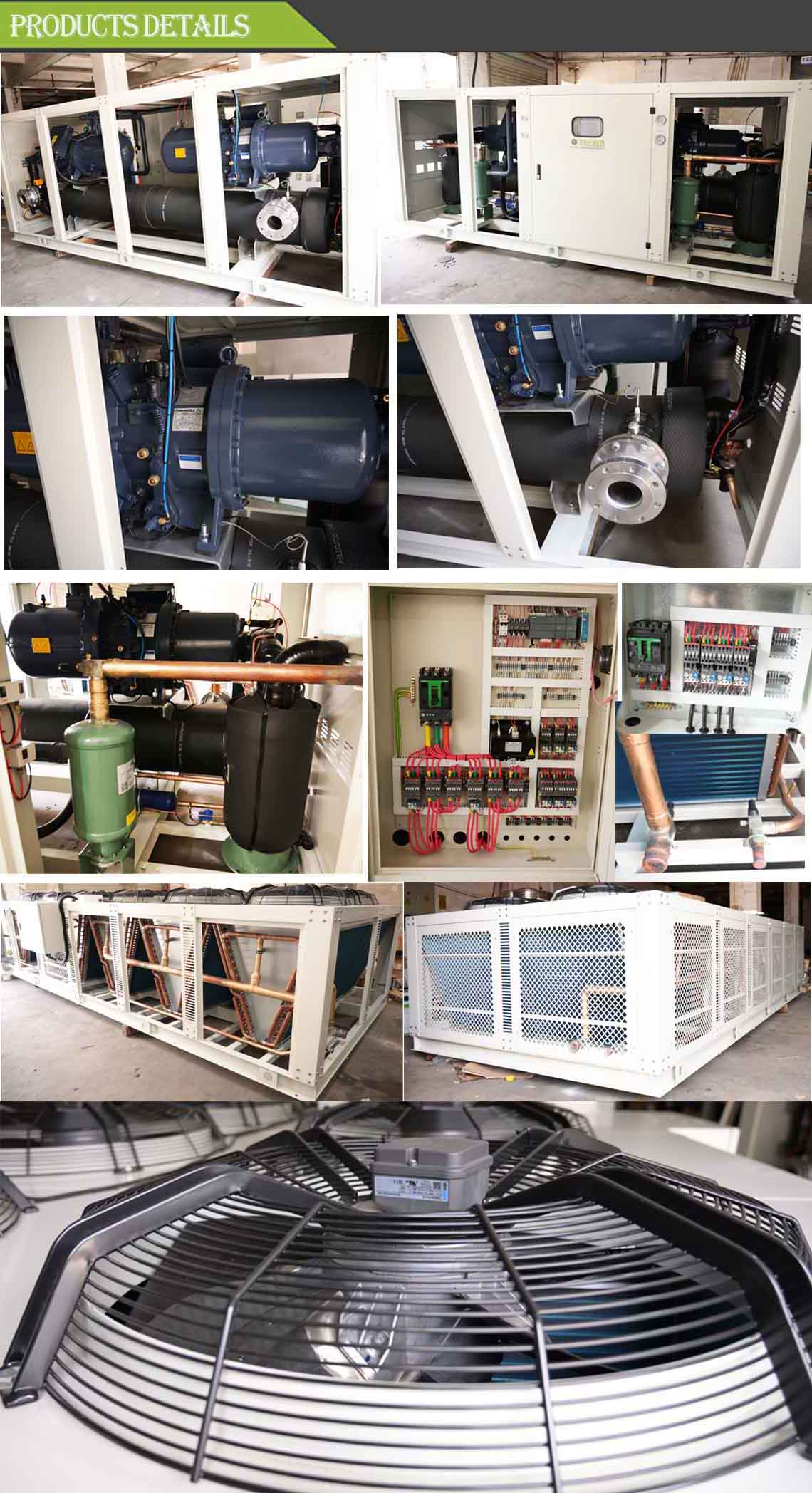
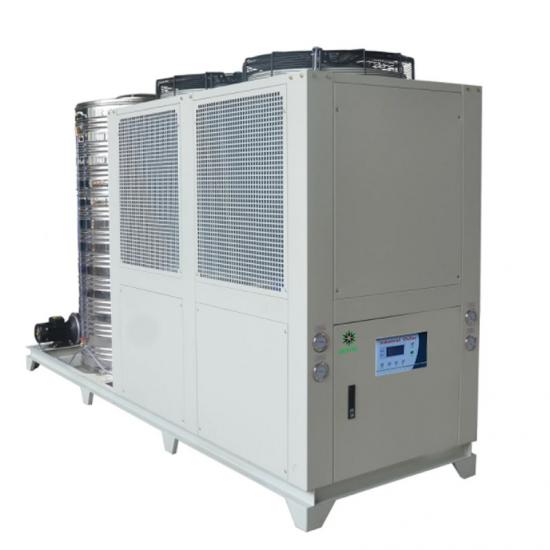
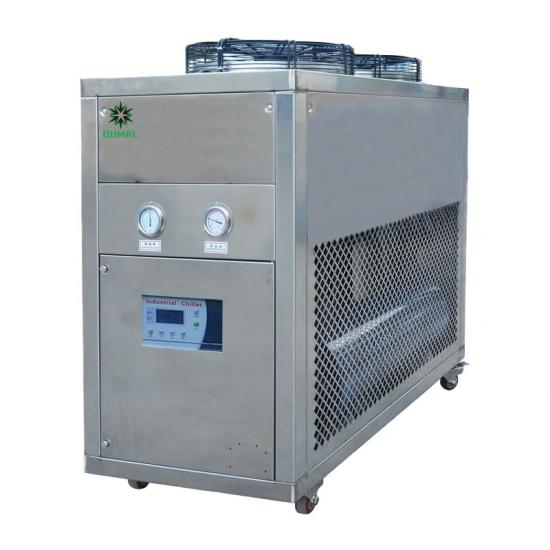
Standard Air Cooled Screw Chiller
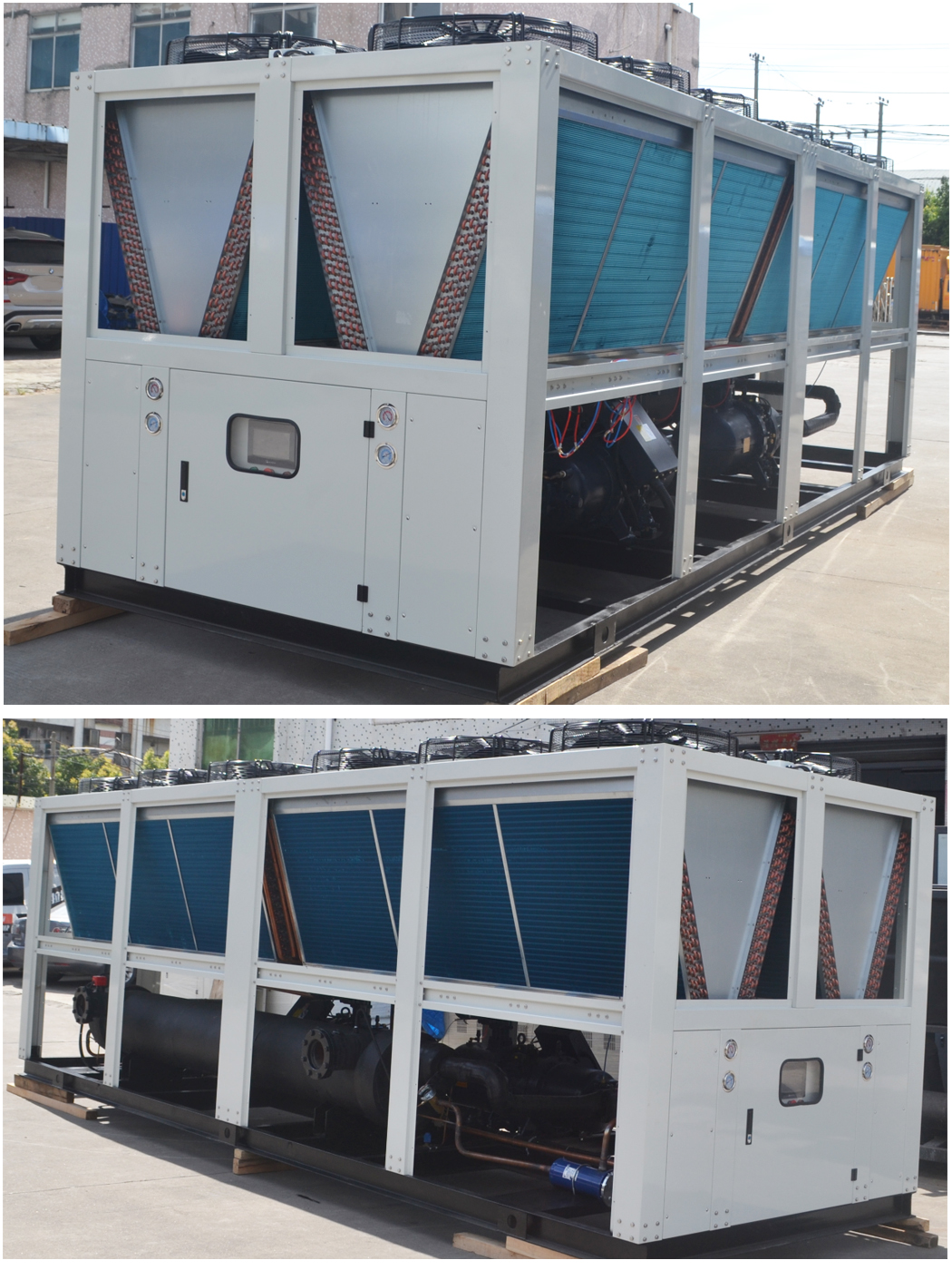
120 TR Split Air Cooled Screw Water Chiller Product Specification
|
1. Split type Air Cooled Screw Chiller Specification |
|||
|
OMC-120ADH |
|||
|
No |
Item |
Specification |
Performance parameters |
|
1 |
Environmental conditions |
Max Ambient Temperature |
+50℃ |
|
Min Ambient Temperature |
-50℃ |
||
|
2 |
Refrigeration system operating conditions |
Evaporating Temp. |
5℃ |
|
Condensing Temp. |
50℃ |
||
|
3 |
Chilled water temperature |
Inlet temperature |
15℃ |
|
Outlet temperature |
10℃ |
||
|
4 |
Coolant |
water |
/ |
|
5 |
Power supply |
|
3P/575V/60HZ |
|
6 |
Input power |
|
133.4KW |
|
7 |
Running Current |
|
71.5A * 2 |
|
8 |
Compressor |
Type |
Semi-Hermetic Screw Type |
|
Cooling Capacity |
426KW (213 * 2) |
||
|
Input Power |
62.3kW * 2 |
||
|
9 |
Condenser |
Type |
Air cooled Type |
|
Heat exchange capacity |
550KW |
||
|
Cooling air Flow |
140000m3/h |
||
|
Input power |
8.8kW |
||
|
10 |
Evaporator |
Type |
Shell and tube |
|
Heat exchange capacity |
426KW |
||
|
Chilled Water flow |
73.3m3/h |
||
|
11 |
Pipes |
Chilled water outlet |
4”(DN100) |
|
Chilled water Inlet |
4”(DN100) |
||
|
12 |
Temperature digital display microcomputer controller |
Display Status |
10-inch human-machine interface/Chinese and English optional touch screen true color display |
|
PLC |
Siemens PLC control system + temperature module |
||
|
Output device selection |
Relay output |
||
|
Temperature Range℃ |
-50~+50 |
||
|
Temperature control accuracy ℃ |
±1.0 |
||
|
13
|
Safety Alarm device |
Abnormal temperature |
Circulating water temperature is too low to alarm and cut off the compressor |
|
Power supply reverse phase/phase loss |
Power phase detection prevents pump and compressor from reversing |
||
|
High and low voltage fault |
Pressure switch detects the pressure status of the refrigerant system |
||
|
Compressor overload |
LS/ Schneider thermal relay |
||
|
Pump Overload |
LS/ Schneider thermal relay |
||
|
Water shortage alarm |
Insufficient water alarm, water pump stops running |
||
|
Refrigerant |
R513A |
||
|
14 |
Chiller Inside Parts Size |
Length*Width*Height(MM) |
3800*1250*1870 (Need to redesign) |
|
15 |
Outside parts condenser size |
Length*Width*Height(MM) |
4800*2150*1500 (Need to redesign) |
|
16 |
Total Weight |
KG |
3800 (inside part about: 2500kg~2600kg Outside part about: 1200kg~1500kg) |
FAQ
Q1: What's the Compressor Brand of your Air Cooled Screw Chiller ?
A1: Regarding the Screw Chiller, We use Hanbell screw compressor mostly, We also use Bitzer Brand if you need. If you are sensitive for the Chiller Price, we can also use Refcomp or other Brands.
Q2: Which Refrigerant type are available for your Air Cooled Screw Chiller?
A2: According to environmental requirements, we provide refrigerant type R407C,R404A,R507A, R134A, R513A or R1234yf for the Air Cooled Screw Chiller. If R22 allowed we can also provide.
Q3: Can you customized the chillers according to our local voltage and frequency and other different requirements?
A3: Each air-cooled chiller is customized according to the voltage and frequency required by the customer to ensure that the chiller meets the working conditions. Therefore, after receiving the inquiry for the chiller, we will always confirm the voltage and frequency with the customer. And we also customized the chiller according to client's different needs.
Q4: What's the warranty?
A4: We offer 15 months warranty for free if confirmed by both side damage in the quality reason.