

Categories
New Blog
When a commercial facility or light industrial production line needs reliable cooling without the complexity of a cooling tower, an air-cooled scroll chiller can be a practical choice. These systems remove heat from circulating water or another compatible fluid and reject it directly into the surrounding air. Their relatively straightforward installation makes them suitable for workshops, small factories, laboratories, commercial buildings, and equipment cooling applications.
However, choosing the right unit involves more than comparing horsepower or purchase prices. Cooling capacity, operating conditions, water temperature, airflow, energy consumption, and maintenance access all affect long-term performance. This guide explains how an air cooled scroll chiller works, where it is used, and what buyers should evaluate before selecting a system.
An air-cooled scroll chiller is a refrigeration system that uses one or more scroll compressors to cool circulating water or another specified process fluid. Instead of relying on a cooling tower to remove heat, it uses fans and an air-cooled condenser to transfer heat into the outdoor or surrounding air.
The scroll compressor uses two spiral-shaped elements to compress refrigerant. One spiral remains stationary while the other moves in a controlled orbit, gradually reducing the refrigerant's volume and increasing its pressure. This compression process is part of the refrigeration cycle that produces chilled water.
Scroll chillers are commonly selected for small and medium cooling loads, although the appropriate capacity depends on the equipment configuration and application. Multiple compressors may be used in a single unit to provide staged capacity control and help match cooling output to changing demand.

The system circulates refrigerant through a closed refrigeration circuit while a separate water circuit delivers cooling to the connected equipment or process. The main components generally include a scroll compressor, condenser coil, condenser fan, expansion device, evaporator, and control system. Depending on the model, a water tank and circulation pump may also be built in.
1. Refrigerant compression: The scroll compressor draws in low-pressure refrigerant vapor and compresses it into a high-pressure, high-temperature vapor.
2. Heat rejection: The hot refrigerant passes through the condenser. Fans move ambient air across the condenser coil, allowing heat to transfer from the refrigerant into the air. The refrigerant then condenses into a high-pressure liquid.
3. Pressure reduction: The liquid refrigerant passes through an expansion device. Its pressure and temperature drop before it enters the evaporator.
4. Heat absorption: In the evaporator, heat transfers from the process water or other compatible fluid into the refrigerant. The fluid becomes cooler and returns to the equipment or process requiring temperature control.
5. Continuous circulation: The refrigerant returns to the compressor, and the cycle repeats. Temperature sensors and the controller regulate operation according to the system's settings and cooling demand.
This arrangement allows an air-cooled chiller to provide process cooling without a separate cooling tower. Actual cooling performance depends on ambient temperature, airflow, fluid flow, heat-exchanger design, refrigerant, and the specified operating conditions.
A compact scroll chiller can be useful where floor space, installation time, and ease of operation matter. Compared with a system that requires a separate cooling tower and associated water circuit, an air-cooled package can reduce the number of auxiliary components needed for heat rejection.
These benefits do not mean every scroll chiller is automatically more efficient than every alternative. Energy consumption should be compared at the actual design conditions, including the required leaving-fluid temperature and local ambient temperature.
Air-cooled scroll chillers can serve applications where stable process temperatures help protect equipment, maintain product quality, or improve production consistency. The final selection should always be based on the process heat load and the manufacturer's approved operating range.
Commercial buildings and facilities: Selected systems can provide chilled water for dedicated cooling equipment, technical rooms, or smaller building applications. The required configuration depends on the building load and whether the chiller is intended for comfort cooling or a specific process.
Plastic processing: Injection molding, extrusion, and blow molding equipment generate heat that needs to be removed. Properly sized process cooling helps maintain mold and equipment temperatures and can support more consistent production.
Laboratories and testing equipment: Certain instruments require controlled cooling to operate within specified temperature limits. Buyers should check temperature stability, flow requirements, and compatibility with the equipment being cooled.
Food and beverage processing: Chillers can cool process equipment and compatible circulation loops. Applications involving food safety or direct product contact require the appropriate hygienic design and process arrangement; an ordinary industrial chiller should not be assumed suitable for direct contact with food.
Electronics and light manufacturing: Selected production machines, testing equipment, and auxiliary systems may need continuous heat removal. The chiller's performance should be verified under the expected load and ambient conditions.

Scroll and screw chillers use different compressor designs and are commonly selected for different capacity requirements. Scroll chillers are often considered for smaller or medium-sized loads, while screw chillers are frequently used for larger industrial cooling demands. These are general selection patterns rather than fixed capacity limits.
| Comparison factor | Scroll chiller | Screw chiller |
|---|---|---|
| Typical project fit | Small to medium cooling loads | Medium to large industrial loads |
| Compressor design | Scroll compression mechanism | Rotating screw compression mechanism |
| System configuration | Single or multiple scroll compressors | Typically a screw compressor-based system |
| Selection priority | Compact installation and load requirements | Higher capacity and industrial operating demands |
Neither compressor type is always the better option. Compare full-load and part-load efficiency, maintenance requirements, initial cost, redundancy, and the expected operating schedule before making a decision. For larger projects, review the available scroll chiller range alongside other industrial cooling configurations.
Before requesting a quotation, prepare the technical information that defines the cooling load and installation conditions. A unit that is too small may struggle to maintain the required temperature, while excessive oversizing can increase upfront cost and may cause inefficient cycling if the control system is not designed for the load profile.
For a smaller installation, buyers can review the air-cooled scroll chiller options and compare the available configurations against their operating requirements.
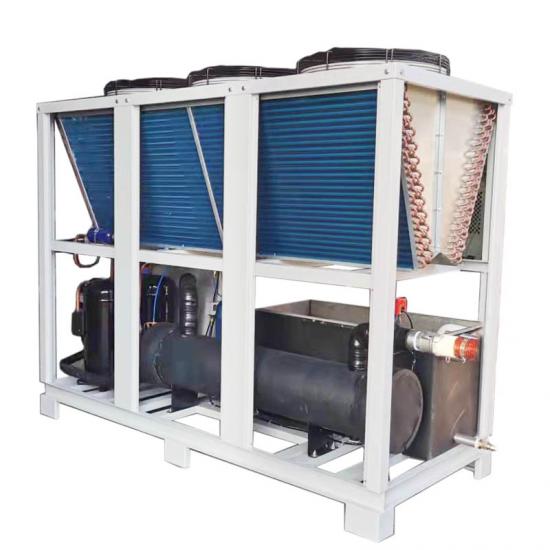
Routine maintenance helps preserve heat-transfer performance and reduce unexpected downtime. Keep condenser coils clean and unobstructed, particularly in dusty production areas. Inspect fans, electrical connections, water pumps, filters, and fluid circuits according to the manufacturer's maintenance schedule.
Operators should also monitor inlet and outlet fluid temperatures, flow rate, operating pressure, and alarm history. A gradual increase in temperature difference or compressor runtime may indicate a change in load, restricted flow, dirty heat-transfer surfaces, or another issue that needs investigation.
Do not set refrigerant pressure targets or adjust refrigerant charge without qualified service personnel. Refrigerant circuit work should follow the manufacturer's procedures and applicable environmental and safety regulations.
1. What is an air-cooled scroll chiller used for?
An air-cooled scroll chiller is used to remove heat from circulating water or another compatible fluid. Common applications include plastic processing, equipment cooling, laboratories, electronics manufacturing, and selected commercial cooling systems.
2. Does an air-cooled scroll chiller need a cooling tower?
No. Its condenser uses fans to reject heat directly into the air, so a separate cooling tower is not required for condenser heat rejection. The installation still needs suitable ventilation, electrical connections, and process-fluid piping.
3. Is a compact scroll chiller suitable for continuous operation?
It can be, provided the model is designed for the required duty and correctly sized for the load. Check the manufacturer's operating limits, ambient-temperature rating, maintenance requirements, and capacity-control method before specifying a unit for continuous production.
4. What is the difference between an air-cooled and water-cooled scroll chiller?
An air-cooled model rejects condenser heat into ambient air, while a water-cooled model transfers heat to a separate cooling-water circuit, usually connected to a cooling tower or another heat-rejection system. The better option depends on site conditions, water availability, energy costs, and maintenance resources.
5. How do I calculate the required chiller capacity?
Start with the process heat load, required fluid temperatures, flow rate, and operating schedule. Consider peak demand and heat gains from piping or the environment. A chiller supplier can use these details to verify capacity under the actual design conditions.
6. Can an air-cooled scroll chiller be customized?
Depending on the manufacturer and model, options may include cooling capacity, pump and tank configuration, heat exchanger type, electrical supply, and control features. Provide the operating conditions and installation requirements when requesting a quotation.
The right chiller should match the actual heat load, fluid temperatures, site environment, and operating schedule—not just the equipment's nominal horsepower. An air-cooled scroll chiller can be a practical option for commercial facilities and light industrial processes that need dependable cooling with a relatively straightforward installation.
OUMAL Chiller provides industrial cooling equipment for different process and commercial requirements. When evaluating a system, share your cooling capacity, inlet and outlet temperatures, fluid type, power supply, and installation environment so the appropriate configuration can be recommended.



Friendly Links :
www.dyyseo.com en
 es