

Categories
New Blog
Choosing the right chiller is an important decision for manufacturers planning a reliable cooling system. While industrial chillers and HVAC chillers both use refrigeration technology to remove heat, they are designed for different operating conditions and cooling requirements. Selecting the wrong type can lead to unstable process temperatures, unnecessary energy consumption, and production interruptions.
So, what is the difference between an industrial chiller and an HVAC chiller? The main distinction lies in what they cool, how they operate, and how they respond to changing loads. An industrial chiller is designed to remove heat directly from manufacturing processes or equipment, while an HVAC chiller primarily provides chilled water for building air conditioning.
For manufacturers, understanding these differences helps determine whether a standard commercial cooling unit or a dedicated industrial process chiller is the better investment.
An industrial chiller is a refrigeration machine designed to remove heat from industrial equipment, production materials, or process fluids. It circulates chilled water or another cooling medium through a closed-loop system to maintain the required operating temperature.
Unlike general building cooling equipment, an industrial chiller is selected according to the actual heat generated by production machinery. It may operate continuously for long production shifts and needs to maintain stable cooling performance even when manufacturing loads change.
Common industrial applications include:

Depending on the cooling capacity and installation environment, industrial chillers can be configured as air-cooled or water-cooled units. Manufacturers can also choose scroll compressors, screw compressors, glycol systems, or customized configurations to match their process requirements.
Explore the industrial chiller range to compare different cooling solutions for manufacturing applications.
An HVAC chiller is primarily used in commercial and institutional air conditioning systems. Its main function is to produce chilled water that removes heat from indoor air through air handling units or fan coil units.
HVAC chillers are commonly installed in:
In a typical chilled-water HVAC system, the chiller cools circulating water, which is then pumped to air handling equipment. The air handling units transfer heat from indoor air to the chilled water, helping maintain comfortable indoor temperatures.
HVAC chillers are generally designed around building cooling loads, occupancy patterns, ventilation requirements, and seasonal temperature changes. Their controls often work together with building management systems (BMS) to adjust cooling output according to the building's demand.
Although some HVAC chillers can support industrial or specialized applications, they are not automatically suitable for direct process cooling. Manufacturers should check the required water temperature, flow rate, operating conditions, and equipment compatibility before selecting one.
The two systems share similar refrigeration principles, but their design priorities are different. The following comparison highlights the main differences that manufacturers should consider.
| Comparison | Industrial Chiller | HVAC Chiller |
|---|---|---|
| Primary purpose | Process and equipment cooling | Building air conditioning |
| Cooling target | Machinery, materials, and process fluids | Indoor air through chilled water systems |
| Temperature requirements | Application-specific, sometimes below 0°C | Generally designed for building cooling requirements |
| Operating conditions | May run continuously under changing production loads | Often follows occupancy and seasonal demand |
| System configuration | Customized pumps, tanks, heat exchangers, and controls | Integrated with air handling and building systems |
| Key selection factors | Heat load, process temperature, flow rate, and production schedule | Building load, indoor comfort, humidity, and energy efficiency |
| Typical users | Factories and manufacturing plants | Commercial buildings and facility operators |
One important point is that neither type is universally more efficient. Actual energy consumption depends on cooling load, operating temperature, ambient conditions, compressor performance, heat exchanger design, and system controls.
Temperature stability is one of the most important differences between industrial and HVAC cooling applications.
In manufacturing, even a small temperature fluctuation can affect product quality. For example, in plastic injection molding, insufficient mold cooling may increase cycle times and cause dimensional variations or surface defects. In metal finishing, unstable cooling can affect the consistency of the treatment process.
An industrial cooling system must therefore be selected based on the actual heat generated by the production equipment, the required inlet and outlet water temperatures, and the expected flow rate.
Some industrial applications also require low-temperature cooling. In these situations, a glycol chiller or specialized low-temperature unit may be more suitable than a standard HVAC chiller.

For example, the 100kW air cooled chiller is designed for industrial cooling applications. Its configuration can include different compressor options, a water tank, circulation pumps, and a 304 stainless steel frame.
For larger cooling loads or lower outlet temperatures, manufacturers may also consider screw chiller configurations. The 110-ton screw water chiller is an example of a low-temperature industrial solution with a 400 kW cooling capacity and a specified outlet water temperature of -3°C.
Industrial facilities often have more demanding operating environments than commercial buildings. High ambient temperatures, dust, vibration, chemical exposure, and long operating hours can all influence chiller selection.
Industrial chillers may require additional design considerations, such as:
HVAC systems, on the other hand, are generally designed around building layouts, equipment rooms, cooling towers, ventilation systems, and centralized building controls.
Air-cooled industrial chillers are often selected when installation flexibility and a simpler cooling-water arrangement are priorities. Water-cooled models can be attractive for larger, continuous cooling loads where a cooling tower and water treatment infrastructure are available.
The right choice depends on the actual cooling task rather than the name of the equipment. Manufacturers should start by identifying what needs to be cooled and how the cooling process affects production.
Choose an industrial chiller when:
Choose an HVAC chiller when:
Some manufacturing facilities need both systems. An HVAC chiller can maintain comfortable working conditions, while a dedicated industrial chiller handles machinery and production cooling. Separating these systems can make temperature control and load management easier.
Before requesting a quotation, prepare the technical information needed for proper equipment selection. This helps the manufacturer recommend a suitable model instead of simply matching the chiller by horsepower.
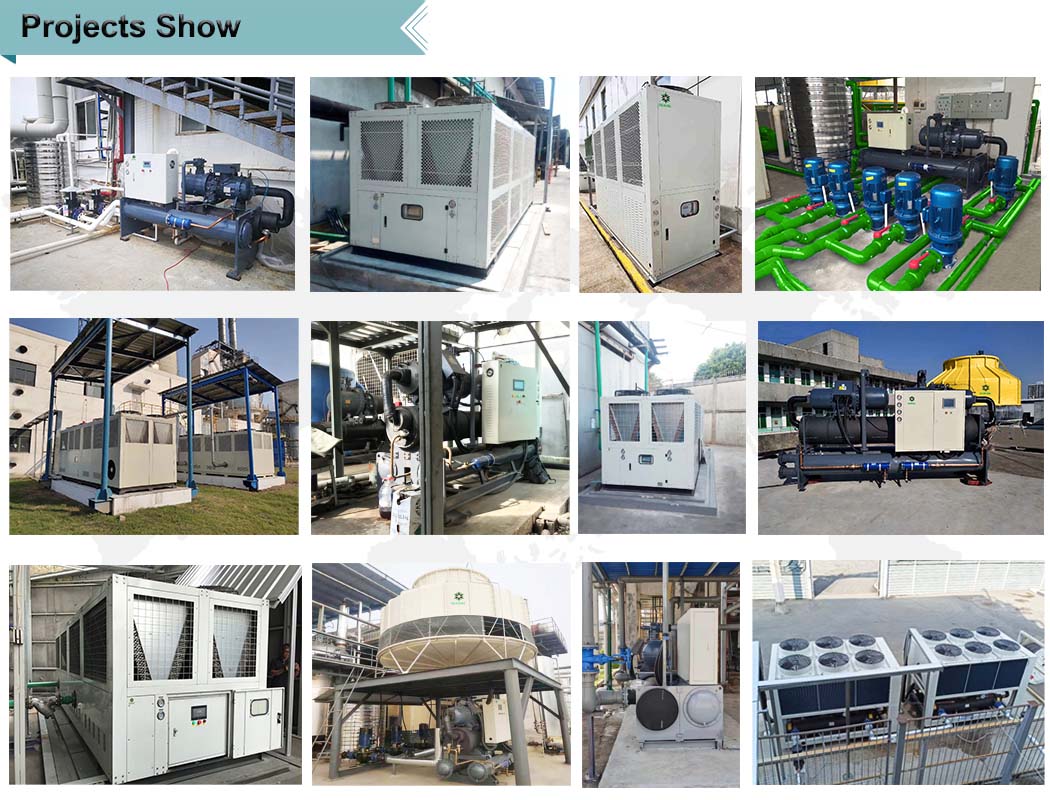
Working with an experienced manufacturer can also simplify system integration and customization. OUMAL Chiller provides industrial water chillers, screw chillers, glycol chillers, and customized cooling solutions for different manufacturing requirements. With more than 15 years of chiller manufacturing experience, OUMAL supports equipment selection, system design, and non-standard customization.
For manufacturers planning a new production line or upgrading an existing cooling system, providing accurate process information is the first step toward selecting a reliable and appropriately sized chiller.
Industrial chillers remove heat from manufacturing processes, machinery, and production fluids. HVAC chillers primarily produce chilled water for building air conditioning. Industrial models are often configured around specific process temperatures, cooling loads, and continuous operating requirements.
In some cases, yes. However, the unit must meet the process temperature, cooling capacity, water flow, and operating requirements. A standard HVAC chiller may not be suitable for applications requiring low temperatures, specialized fluids, or demanding production conditions.
Many industrial chillers are designed for extended or continuous operation in manufacturing facilities. Actual operating capability depends on the model, cooling load, ambient conditions, maintenance schedule, and system configuration.
Air-cooled chillers are generally easier to install and do not require a cooling tower. Water-cooled chillers can offer higher energy efficiency under suitable conditions but require additional cooling-water infrastructure. The best option depends on plant layout, climate, water availability, and operating costs.
Start by identifying the heat generated by the equipment or process, the required water temperature, and the circulation flow rate. Consider operating hours, ambient conditions, and load variations. A chiller manufacturer can use these parameters to calculate the required cooling capacity and recommend an appropriate model.



Friendly Links :
www.dyyseo.com en
 es