
Categories
Compared to HVAC chillers, the selection of industrial chillers is more complex. This is because industrial chillers operate under complex conditions, and each user has different temperature requirements and installation environments. Industrial chillers aim to provide stable, precise, and large temperature differences to meet process requirements, with control systems focusing more on process integration and safety; while air conditioning units aim to provide comfort, wide-range variable frequency operation, and high energy efficiency for human living environments, with control systems focusing more on intelligent regulation and energy optimization.
When you need to purchase an industrial chiller, simply considering the industrial chiller price is completely insufficient. Comparing the chiller prices of different chiller manufacturers for a single model is also not an effective way to select the right industrial chiller. When purchasing an industrial chiller, you need to consider various factors comprehensively, including technical parameters, operating conditions, required outlet water temperature, the highest ambient temperature in summer, the matching size and materials of the condenser and evaporator, service support, and the price of the chiller.
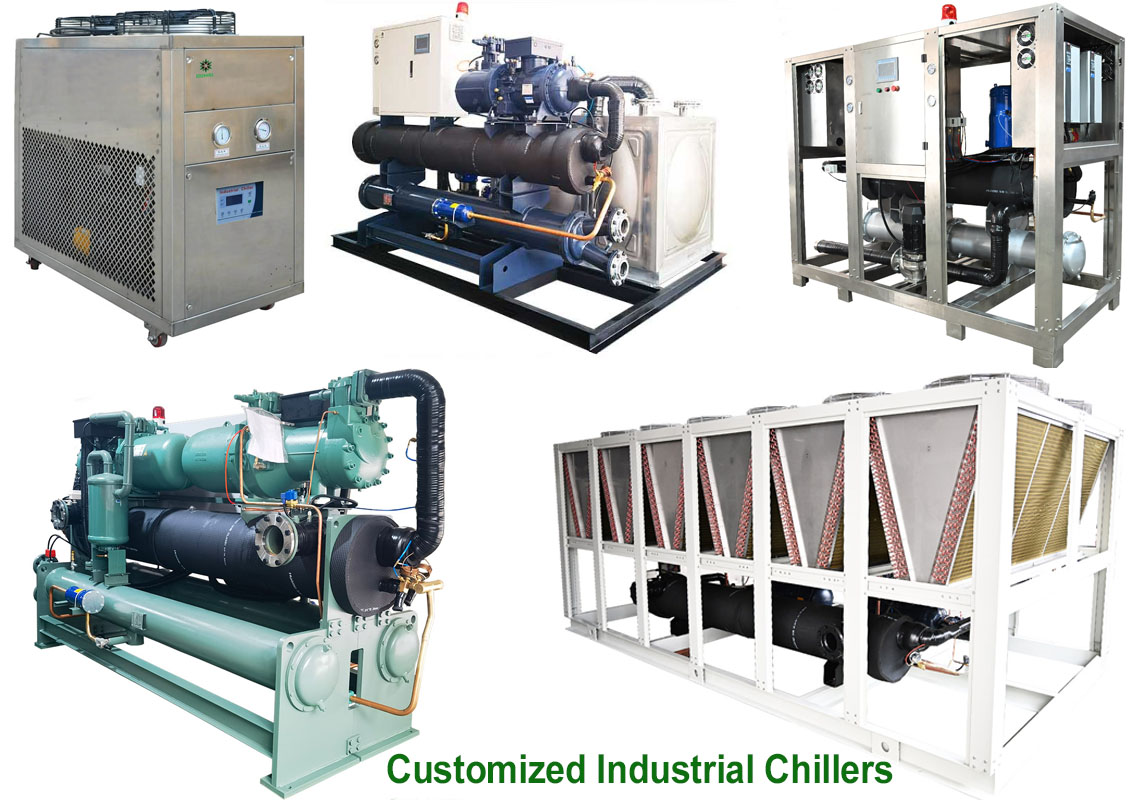
Clearly define core process parameters: First, accurately determine the cooling capacity, temperature control accuracy, and cooling medium. The cooling capacity should be calculated based on equipment heat generation, environmental heat dissipation, etc., with a 10%-20% margin. Temperature accuracy should be selected according to the application scenario; for example, high-precision electronic manufacturing requires ±0.1℃, while general industrial cooling can use ±1℃-±2℃. Regarding the cooling medium, water is low-cost and has high heat transfer efficiency, suitable for conventional cooling, while ethylene glycol solution has a low freezing point and is suitable for low-temperature or anti-freeze applications. If a low-temperature chiller is needed, and an ethylene glycol chiller is required, if the budget allows, it is recommended to use a stainless steel evaporator to effectively extend the service life of the glycol chiller.
Evaluate environmental and installation conditions: The installation environment directly affects equipment selection. Consider the space size, ventilation conditions, temperature and humidity range, and whether there are corrosive or explosion-proof requirements; indoor installation requires attention to high temperatures and dust, and may require the addition of filters or heaters; outdoor installation requires adaptation to extreme temperature differences; sufficient maintenance space should also be reserved, and the power supply should be checked for compatibility. If water sources are scarce and the water quality is poor, an air-cooled chiller is recommended. Is the cooling medium corrosive? Is it fresh water or seawater? If it is corrosive, you must inform the chiller manufacturer so that corrosion-resistant materials can be used to ensure that the chiller evaporator is not corroded, as conventional industrial chillers use copper tubes in their evaporators.
Focus on energy efficiency and operating economics: The Coefficient of Performance (COP) is a key indicator; high-efficiency equipment can significantly reduce long-term operating costs. Water-cooled units have a high cooling coefficient but require a larger initial investment, while air-cooled units are easier to install but consume more energy. A balance must be struck based on water source conditions and electricity prices. Modular design supports phased expansion, avoiding wasted initial investment. The choice between single-compressor and dual-compressor systems for screw chillers is also a common concern during chiller procurement. If the budget allows, a dual-compressor system is recommended, as the compressors adjust according to the load, saving energy.
Verify technical performance and reliability: The brand and quality of core components such as compressors and condensers directly affect stability. Prioritize first-tier brand components and confirm that complete safety protection functions are in place. For complex operating conditions (such as pharmaceuticals and chemicals), verify whether the supplier has successful cases in the same industry and pay attention to whether the control logic supports intelligent adjustment. Predictive maintenance functions (such as vibration monitoring) can reduce downtime. Oumal chillers use international top-brand compressors, such as Copeland, Danfoss, and Panasonic for scroll compressors, and Hanbell, Bitzer, and Refcomp for screw compressors.



Friendly Links :
www.dyyseo.com en
en es
es