
Categories
Water cooled chiller technology delivers superior performance when you need reliable industrial cooling. You find water-cooled chillers preferred in demanding environments because they offer high energy efficiency and advanced control systems. The 500kw water cooled screw chiller stands out as a robust solution for industries that require precise temperature management and long-term reliability.
Water cooled chillers outperform air-cooled units in energy efficiency.
Advanced heat exchangers and intelligent controls boost operational efficiency.
The market for water-cooled chillers continues to grow in industrial settings.
Manufacturing relies on water cooled chiller systems to maintain equipment performance.
Commercial buildings use water-cooled chillers to reduce energy costs.
Food and beverage producers depend on constant temperature control.
Pharmaceutical labs trust water-cooled chiller technology for product integrity.
You benefit from energy efficiency, reliability, precise control, and versatile applications across many industries.
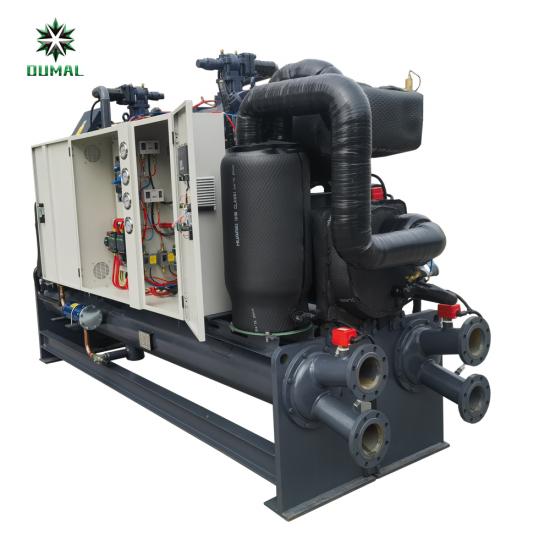
Water-cooled chillers are more energy-efficient than air-cooled models, leading to lower utility bills.
Advanced technology in water-cooled chillers allows for precise temperature control, essential for industries like pharmaceuticals and food processing.
Regular maintenance of water-cooled chillers is crucial for optimal performance and longevity, helping to avoid costly repairs.
Investing in a water-cooled chiller can result in significant long-term savings, with a typical payback period of around four years.
These chillers operate quietly, making them suitable for environments where noise reduction is important.
You need consistent, high-capacity cooling for industrial processes. Water-cooled chillers deliver this reliability by using water as the cooling medium. This method allows you to achieve stable temperatures, even when your facility operates under heavy loads. Many large-scale operations, such as data centers and shopping malls, have switched to water-cooled chillers to reduce energy use and improve cooling performance. For example, a major shopping mall in Asia saw a 15% drop in energy consumption after upgrading to a centrifugal chiller system. In North America, a data center achieved a 20% reduction in energy use during peak hours by using water-cooled chillers.
Water cooled chiller systems use a cooling tower to remove heat, making them more efficient than air-cooled models. You benefit from this design, especially in large facilities where cooling performance is critical. The 500kw water cooled screw chiller stands out because it uses dual Hanbell compressors. These compressors operate efficiently, even when your system runs at partial load, which happens most of the time in real-world conditions. You also get customizable temperature control, so you can set precise temperatures for your process.
Tip: Stable temperature control improves product quality in industries like food processing and pharmaceuticals.
Here is a comparison of water-cooled and air-cooled chillers:
|
Chiller Type |
Cooling Method |
Efficiency in High Temperatures |
Installation & Maintenance |
|---|---|---|---|
|
Water-Cooled |
Uses water for cooling |
Higher efficiency |
More complex |
|
Air-Cooled |
Uses ambient air |
Lower efficiency |
Easier to install |
You can see that water-cooled chillers provide higher efficiency, especially in demanding environments.
Modern water-cooled chillers use advanced screw compressor technology to boost efficiency and reliability. The dual Hanbell compressors in the 500kw chiller allow you to maintain high cooling performance, even when your system does not need to run at full capacity. This feature is important because chillers often operate at partial load over 90% of the time. The compressors adjust their output to match your needs, which saves energy and reduces wear.
You also benefit from stepless capacity control. This feature lets you adjust the cooling output smoothly from 25% to 100%. You get precise temperature management, which is vital for industries that require strict control, such as chemical processing and plastics manufacturing. Advanced control systems, like Siemens PLC and HMI, allow you to monitor and adjust your chiller in real time.
Here are some key features that help maintain precise temperature control:
|
Feature |
Explanation |
|---|---|
|
Stepless Capacity Control |
Allows continuous adjustment of cooling capacity between 25% to 100%, ensuring precise energy output. |
|
Advanced Control Systems |
Enables real-time monitoring and adjustments to optimize performance based on ambient temperature changes. |
|
Efficient Heat Exchange |
Utilizes a cooling tower or circulation system for effective heat dissipation, maintaining stable operation. |
Recent advancements in screw compressor design have made water-cooled chillers even more efficient. Variable-speed drives let the compressor adjust its speed, which helps maintain consistent temperatures and saves energy. Oil recovery systems keep the compressor running smoothly. Smart control systems monitor performance and make real-time adjustments. Inverter-driven compressors match the cooling load, so you get high efficiency at both full and part load conditions.
Here is a summary of key energy efficiency metrics for water-cooled chillers:
|
Metric |
Description |
|---|---|
|
SEER |
Measures cooling efficiency over an entire season, indicating energy efficiency with higher values being better. |
|
EER |
Focuses on instantaneous energy efficiency under specific conditions, providing a snapshot of performance. Higher values indicate better efficiency. |
|
COP |
Measures the ratio of cooling output to electrical power input, with higher values indicating more effective energy conversion. |
You should also pay attention to water quality in your system. Proper water quality prevents corrosion and scaling, which keeps your chiller running efficiently.
|
Parameter |
Acceptable Range |
Impact of Poor Quality |
|---|---|---|
|
pH Level |
6.5 - 8.5 |
Prevents corrosion and scaling; too low or high can lead to system failure. |
|
Total Dissolved Solids (TDS) |
Below 2000 ppm |
High levels can cause scale formation and corrosion, affecting efficiency. |
|
Hardness |
Below 200 ppm (CaCO3 eq.) |
High hardness can lead to scale formation, reducing heat transfer efficiency. |
|
Microbiological Contamination |
Controlled with biocides |
Excessive microorganisms can clog pipes and reduce efficiency. |
|
Suspended Solids |
Below 10 ppm |
Can cause abrasion and fouling, reducing heat transfer and increasing pressure drop. |
By choosing a water-cooled screw chiller, you gain access to advanced technology, high cooling performance, and reliable operation for your industrial needs.
You can achieve significant long-term cost savings by choosing a water cooled chiller for your facility. Water-cooled chillers optimize energy use through advanced compressor technology and smart control systems. The Siemens PLC central control unit gives you timely and accurate control over cooling capacity and load matching. This ensures your chiller always runs at optimal efficiency, which lowers your operating costs.
Smart controls let you track system status and historical trends. You can use predictive maintenance features to prevent failures and extend equipment life. Remote access allows you to manage your chiller from anywhere, giving you more convenience and control. These features help you reduce power consumption and avoid unnecessary downtime.
Tip: Real-time monitoring and adjustments keep your energy levels optimal, so you save money every month.
If you invest in a water-cooled screw chiller, you can expect a payback period of about four years. For example, if a chiller costs $100,000 and saves $20,000 annually in energy costs plus $5,000 in maintenance savings, you will recoup your investment in roughly four years. This makes water-cooled chillers a smart choice for long-term financial planning.
Routine maintenance keeps your chiller running efficiently and helps you avoid expensive repairs. Water-cooled chillers feature easy access panels and modular components, which simplify upkeep. You can follow a regular schedule to maintain your system and maximize uptime.
Here is a table showing common maintenance intervals and their impact on operational uptime:
|
Maintenance Interval |
Tasks |
Impact on Uptime |
|---|---|---|
|
Daily |
Test water chemistry, clean strainers, check electrical connections |
Prevents minor issues from escalating |
|
Weekly |
Inspect condenser water regulating valve, check oil return system |
Ensures efficient operation |
|
Monthly |
Check compressor oil, inspect motor starter contacts |
Maintains optimal performance |
|
Quarterly |
Clean water strainers, inspect vanes and bearings |
Reduces risk of breakdowns |
|
Semi-Annual |
Check capacity control system, send oil sample for analysis |
Identifies potential failures early |
|
Annual |
Perform refrigerant leak test, conduct full system performance test |
Ensures long-term reliability and efficiency |
You benefit from water-side maintenance that prevents scaling and corrosion. Refrigerant-side maintenance includes leak detection and oil analysis. Electrical maintenance ensures proper connections and calibration. Mechanical maintenance focuses on vibration monitoring and lubrication. These tasks help you keep your chiller running smoothly and reduce overall expenses.
Water-cooled chillers offer you reliable performance and lower costs over time. You gain peace of mind knowing your system will deliver consistent cooling and savings year after year.
You need chillers that can handle the demands of industrial environments. Water-cooled chillers stand out because they use strong materials and advanced engineering. When you choose a chiller for your facility, you want it to last for many years. The 500kw water cooled screw chiller uses a heavy-duty frame and reinforced components. This design helps the unit withstand vibration, pressure changes, and continuous operation.
Chillers play a key role in chemical processing plants. These facilities require stable cooling to keep processes safe and efficient. If you work in a chemical plant, you know that even a small temperature change can cause big problems. Water-cooled chillers provide consistent cooling, which protects your equipment and keeps your operations running smoothly. You can trust these chillers to deliver reliable performance, even when conditions are tough.
Note: Reliable chillers help prevent costly downtime and protect your investment.
You face many challenges when you operate in harsh environments. Corrosive chemicals and low temperatures can damage ordinary equipment. Water-cooled chillers use special materials to fight corrosion and extend service life. The 500kw water cooled screw chiller features an evaporator shell made from 316 stainless steel and inner tubes made from nickel white copper. These materials resist corrosion and keep your chiller working efficiently.
Here is how these materials enhance durability:
|
Material |
Application |
|---|---|
|
316 Stainless Steel |
Used for the evaporator shell due to its corrosion resistance in harsh environments. |
|
Nickel White Copper |
Utilized for the inner tube to enhance protection against corrosion. |
Nickel white copper works well in low temperature environments and with certain chemicals. This makes it a smart choice for industries like pharmaceuticals and plastics. You get a chiller that lasts longer and requires less maintenance. When you invest in water-cooled chillers, you choose equipment built for the toughest jobs.
You want a cooling solution that works efficiently without adding unnecessary noise to your facility. Water cooled screw chillers offer a quieter operation compared to many air-cooled models. You can expect noise levels in the range of 55 dB to 75 dB, which is similar to the sound of gentle rainfall. A well-maintained water cooled chiller often operates around 60 dB at a distance of one meter. This low noise level helps you create a more comfortable and productive work environment, especially in industries where noise reduction matters.
Smaller water-cooled chillers: 60 - 70 dB at 1 meter
Larger industrial water chillers: 70 - 90 dB at 1 meter
Well-designed water-cooled chillers: around 60 dB
You benefit from this quiet performance, especially when you need to maintain focus and safety in your workspace.
You can rely on water cooled screw chillers for a wide range of industrial applications. These chillers adapt easily to the needs of pharmaceuticals, plastics, food processing, and more. In pharmaceutical manufacturing, you need precise temperature control to protect sensitive products. In plastics production, chillers help you maintain stable temperatures during injection molding and extrusion, which ensures consistent quality and efficiency.
Water cooled screw chillers also support food and beverage processing by keeping production lines at optimal temperatures. You can use these chillers in breweries, chemical plants, and other demanding environments. Their versatility makes them a smart investment for many industries.
You also support environmental sustainability when you choose modern chillers. Many water cooled screw chillers use eco-friendly refrigerants that reduce environmental impact. Here is a comparison of common refrigerant options:
|
Refrigerant Type |
Global Warming Potential (GWP) |
Ozone Depletion Potential (ODP) |
Notes |
|---|---|---|---|
|
Hydrocarbons |
Very low (close to zero) |
Zero |
Natural, energy-efficient, requires safety measures |
|
Carbon Dioxide |
1 |
Zero |
Reliable, efficient, advanced technology |
|
Ammonia |
Very low |
Zero |
Highly efficient, requires strict safety regulations |
You help your facility meet environmental regulations by using chillers that consume less energy and use closed-loop water systems. These features lower your carbon footprint and support water conservation efforts.
Tip: Choosing the right chiller helps you achieve both operational excellence and environmental responsibility.
When you compare water-cooled chillers to air-cooled chillers, you notice clear differences in efficiency and performance. Water-cooled chillers use water to remove heat, which makes them more effective in large or demanding industrial settings. Air-cooled chillers rely on air, so they often work harder in hot environments and may not cool as efficiently.
Here is a quick comparison:
|
Chiller Type |
Energy Efficiency |
Cooling Performance |
|---|---|---|
|
Water Cooled Screw |
Higher efficiency |
More effective cooling |
|
Air Cooled |
Lower efficiency |
Less effective cooling |
You see that water-cooled chillers deliver better energy efficiency and cooling performance. Over time, this means you spend less on electricity and get more reliable cooling for your processes.
You should also consider the cost differences. Air-cooled chillers usually have a lower initial price, but they may cost more to run over the years. Water-cooled chillers need a bigger investment at first, but they save you money in the long run because they use less energy and last longer.
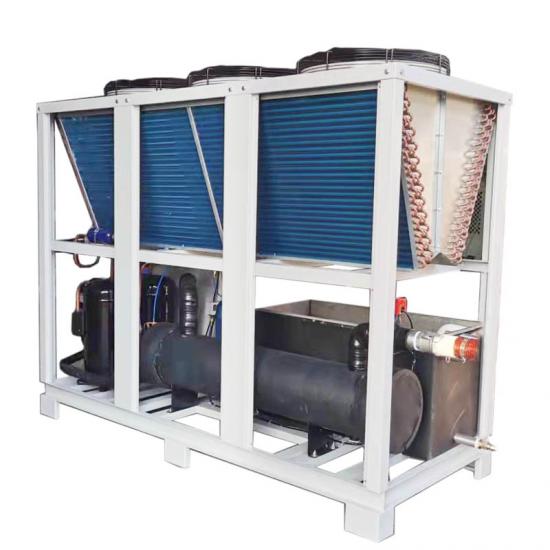
Water-cooled chillers stand out for several reasons:
They offer higher energy efficiency, which lowers your utility bills.
They have a longer lifespan and require less maintenance.
They provide stable cooling, even in extreme conditions.
You may pay more upfront for a water-cooled chiller, but you benefit from lower operating costs and fewer repairs. For example, a 200-ton air-cooled chiller might cost $250,000, while a water-cooled chiller of the same size could cost $340,000. However, the water-cooled option usually lasts longer and costs less to operate.
Tip: If your facility runs all day or handles sensitive processes, water-cooled chillers give you the best value over time.
You can rely on water-cooled chillers for consistent performance, energy savings, and durability. These advantages make them a smart choice for many industries that need dependable cooling.
You gain many advantages when you choose a water cooled screw chiller for your industrial facility. These chillers deliver high energy efficiency, lower operational costs, and long service life. Facility managers often select them because they work well in high temperatures and offer reliable performance.
Lower condensing temperatures reduce compressor workload.
Operational costs stay low over time.
Indoor installation extends equipment lifespan.
To select the right chiller, consider your heat load, facility type, and equipment needs. For the best results, consult a cooling specialist who can match a solution to your unique requirements.
You find these chillers in pharmaceuticals, plastics, food processing, and chemical plants. They work well where precise temperature control and high-capacity cooling are critical for production quality and safety.
You save energy because these chillers use efficient compressors and advanced control systems. Water as a cooling medium removes heat more effectively, which reduces power consumption compared to air-cooled models.
You should check water quality, clean strainers, and inspect compressors regularly. Routine maintenance helps prevent corrosion, scaling, and mechanical issues, ensuring reliable operation and a longer service life.
Yes, you can set the water outlet temperature to match your process needs. For example, the 500kw water cooled screw chiller allows you to reach temperatures as low as 10.4°F for specialized applications.
You support sustainability by choosing models with eco-friendly refrigerants and efficient designs. These chillers use less energy and often feature closed-loop water systems, which help reduce environmental impact.



Friendly Links :
www.dyyseo.com en
en es
es