
Categories
New Blog
You face several challenges when selecting the optimal choice for a water cooled chiller. Many industries struggle with getting capacity calculations right, overlooking installation environments, and neglecting maintenance needs. Matching chiller features to your specific process ensures reliable performance and cost efficiency. If you consider future growth and compatibility with existing systems, you increase operational stability. This guide helps you balance cost, performance, and reliability for your industrial cooling solution.
Calculate your cooling load accurately to determine the right chiller size and type for your industrial process.
Prioritize energy efficiency when selecting a chiller to reduce operational costs and support sustainability goals.
Consider both initial and long-term costs, as water-cooled chillers may have higher upfront costs but offer significant savings over time.
Regular maintenance is essential for optimal chiller performance; schedule inspections to prevent issues and extend lifespan.
Consult with experts and evaluate vendors carefully to ensure you choose a chiller that meets your specific operational needs.
You need to start by calculating the cooling load for your industrial process. This step helps you determine the size and type of chiller required. Follow these steps to get accurate results:
Identify all heat sources in your facility, including machinery, material throughput, and ambient heat gains.
Determine the fluid type and calculate the flow rate based on your cooling needs.
Account for environmental conditions such as ambient temperature, altitude, and duty cycle.
Match the required cooling capacity to the right chiller configuration.
Validate your calculations and plan for future expansion.
Tip: Reviewing your cooling load calculations with an expert can help you avoid costly mistakes and ensure your chiller meets both current and future demands.
The scale of your industrial application directly affects the cooling capacity and chiller size you need. Consider the following points:
Large-scale operations require robust chillers to handle higher heat loads and maintain consistent cooling.
Smaller applications may benefit from compact chillers with flexible cooling capacity.
Efficiency and future expansion play a critical role in selecting the right chiller for your facility.
You should evaluate your production volume and process intensity. This assessment helps you choose a chiller that delivers reliable performance and supports growth.
Site conditions and water quality impact the performance and longevity of your chiller. Pay attention to these factors:
High mineral content, such as calcium and magnesium, can cause scale formation and reduce efficiency.
Corrosive elements like chlorides and sulfates may damage metal surfaces and increase repair costs.
Biological growth, including algae and bacteria, can form biofilms that hinder heat transfer and pose health risks.
Scale, algae, and suspended solids significantly reduce heat transfer efficiency.
Note: Regular inspection and maintenance of water quality are essential to prevent performance degradation and extend the life of your chiller.
By carefully defining your cooling needs, you lay the foundation for selecting a chiller with the right cooling capacity and features for your industrial process.
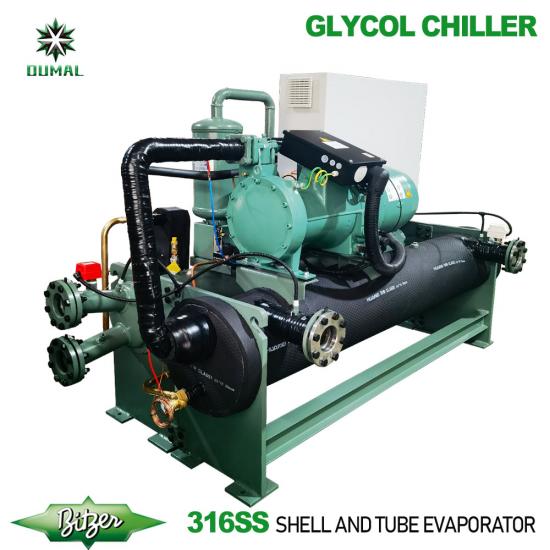
You need to prioritize energy efficiency when selecting an industrial chiller. Water-cooled chillers deliver superior cooling efficiency compared to air-cooled systems because water absorbs heat more effectively. This results in lower electricity consumption and reduced operational costs. Manufacturers design these chillers to meet ISO and ASHRAE standards, ensuring optimal performance and compliance with regulations. Many modern water-cooled chillers feature variable speed drives and advanced heat exchangers that optimize power usage. The OUMAL Water Cooled Screw Chiller Glycol Chiller 40 tr stands out with its Bitzer semi-hermetic screw compressor and Siemens PLC control system, which maintain stable temperatures and maximize energy efficiency. You benefit from reduced carbon footprints and significant energy savings, especially in large-scale industrial applications.
Water-cooled chillers consume less electricity, leading to lower operational costs.
Advanced control systems and efficient heat exchangers enhance energy efficiency.
Compliance with ISO and ASHRAE standards ensures reliable performance.
Variable speed drives optimize power usage and improve performance under part-load conditions.
Tip: Choosing a water-cooled chiller with high energy efficiency helps you meet sustainability goals and lowers your long-term expenses.
You must consider both initial and long-term costs when evaluating an industrial chiller. The purchase and installation cost for water-cooled chillers averages around $1,000 per ton of cooling capacity, or about $300 per kW-th. Additional expenses may arise from installation and auxiliary systems such as cooling towers and pumps. While air-cooled chillers often have lower upfront costs, water-cooled chillers provide substantial operational savings over time due to their higher energy efficiency. Over a ten-year period, you can expect reduced maintenance frequency and lower utility bills, making water-cooled chillers a cost-effective choice for industrial applications.
Water-cooled chillers require less frequent maintenance, reducing operational costs.
Lower electricity consumption leads to significant savings over time.
Initial investment is higher, but long-term benefits outweigh the upfront expense.
You need to plan for adequate space when installing a water cooled chiller. These systems require room for the chiller unit, cooling tower, pumps, and associated mechanical equipment. Proper water supply and drainage systems are essential for efficient operation. Installation constraints such as available space, site access, noise restrictions, and local water use regulations influence your selection. For example, limited space may require a compact chiller, while noise-sensitive environments benefit from quieter models like the OUMAL 40 tr. You must ensure your facility can support the chiller’s operation and accommodate all necessary components.
Note: Assess your site thoroughly before installation to avoid costly modifications and ensure smooth operation.
You must establish a regular maintenance schedule to keep your industrial chiller operating efficiently. Water-cooled chillers require periodic cleaning and water treatment to prevent scaling, corrosion, and algae buildup. Cleaning condenser tubes quarterly or yearly maintains optimal heat transfer and prevents fouling. Regular inspections and servicing extend the lifespan of your chiller and help identify potential issues before they escalate. Compared to air-cooled chillers, water-cooled chillers need less frequent maintenance, which reduces operational costs over time.
|
Chiller Type |
Maintenance Requirements |
Cost Implications |
|---|---|---|
|
Air-Cooled |
Regular cleaning of fans and coils to prevent dust buildup |
Lower maintenance costs |
|
Water-Cooled |
Cleaning and water treatment to prevent scaling and algae |
Higher operational costs initially |
Regular maintenance ensures efficient operation and longevity.
Early detection of issues reduces the risk of unexpected failures.
Water-cooled chillers typically have lower energy costs but higher maintenance and water costs.
You must comply with environmental regulations when selecting a water-cooled chiller for industrial use. Standards such as ISO 5151, ISO 13256, ASHRAE 90.1, ASHRAE 15, EN 378, and the Montreal Protocol address performance, safety, energy efficiency, and refrigerant management. Water-cooled chillers help reduce greenhouse gas emissions and support sustainability goals. Many models use environmentally friendly refrigerants and smart control systems to minimize environmental impact. Closed-loop water chillers recirculate water, reducing waste and conserving resources. By choosing a chiller that meets these standards, you ensure safe operation and contribute to environmental protection.
Alert: Always verify that your industrial chiller complies with local and international environmental standards to avoid penalties and support sustainable operations.
You need to evaluate compressor type, temperature range, and control systems when selecting a water-cooled chiller. The OUMAL Water Cooled Screw Chiller Glycol Chiller 40 tr offers advanced controls, robust safety features, and precise temperature management, making it ideal for demanding industrial applications. By considering these criteria, you ensure your chiller delivers reliable performance and meets your facility’s cooling requirements.
You need to understand the key comparison factors between screw and centrifugal chillers before making a decision. Screw chillers, like the OUMAL 40 tr, deliver reliable cooling capacity for chemical, pharmaceutical, plastics, and food industries. These chillers operate efficiently under part-load conditions and produce lower noise levels. Centrifugal chillers suit large-scale facilities and perform best at full-load conditions. You can see the main differences in the table below:
|
Aspect |
Screw Chillers |
Centrifugal Chillers |
|---|---|---|
|
Capacity Range |
Small to medium |
Large-scale |
|
Load Suitability |
Part-load conditions |
Full-load conditions |
|
Examples |
Data centers, Hospitals |
Airports, Malls |
|
Energy Efficiency |
Up to 15% less energy at partial loads |
Higher efficiency at full loads |
|
Maintenance |
Easier and cheaper |
More expensive |
|
Noise Levels |
Lower (75 dB(A)) |
Higher (80 dB(A)) |
You benefit from screw chillers when you need flexibility and lower maintenance costs. Centrifugal chillers offer high cooling capacity for massive operations but require more complex maintenance.
Water-cooled screw chillers use less electricity for large loads.
Advanced screw chillers, such as the OUMAL 40 tr, feature eco-friendly refrigerants and PLC controls for enhanced efficiency.
Reciprocating chillers fit smaller industrial applications and commercial buildings. You choose these chillers when cost matters most. Absorption chillers work well in large facilities that can use waste heat or steam. They operate with an absorber, pump, and generator, using distilled water and Lithium Bromide.
|
Advantages |
Disadvantages |
|---|---|
|
Efficient use of waste heat |
Higher complexity |
|
Lower electrical consumption |
Requires constant heat source |
|
|
More expensive initial setup |
Absorption chillers range from 20 to 1,500 tons in cooling capacity.
Reciprocating chillers provide reliable performance for smaller loads.
Modern water-cooled chillers include advanced control systems that optimize operation. You gain efficiency through real-time data analytics and predictive algorithms. Variable speed drives adjust motor speeds to match cooling demand. Chiller sequencing selects the best combination of chillers based on demand. Variable primary flow systems improve part-load efficiency. Cooling tower optimization reduces energy consumption.
Tip: Advanced controls help you maximize operational efficiency and reduce energy costs.
You should evaluate these features to ensure your chiller meets your facility’s needs and delivers consistent cooling capacity.
You start by evaluating your facility to ensure the chiller fits your operational needs. A thorough site assessment considers weather data, building load characteristics, and operational hours. You analyze how outside conditions affect condenser performance and calculate the energy drawn by auxiliary systems. The table below highlights key factors:
|
Key Factors |
Description |
|---|---|
|
Comprehensive Analysis |
Includes weather, building load, operational hours, and auxiliary energy. |
|
Operating Conditions |
Efficiency depends on chiller type and real-world conditions. |
|
Weather Impact |
Ambient conditions influence condenser operation. |
|
Building Load Profile |
Helps determine chiller operating costs. |
|
Unloading Curve |
Analyze chiller performance at different load levels. |
|
Dynamic System Analysis |
Match chiller selection to building load and compression methods. |
You also review facility conditions, installation space, and environmental factors like temperature and humidity. Stable load profiles and increased operating hours improve chiller efficiency.
You benefit from consulting industry experts before making a final decision. Experts help you define cooling requirements and verify manufacturer credentials. They provide guidance on aligning your chiller selection with energy-saving strategies and decarbonization goals. You gain insight into the best chiller type for your facility and receive advice on long-term value and scalability.
Tip: Engage with professionals early to avoid costly mistakes and ensure your chiller meets all operational demands.
You evaluate vendors based on efficiency, reliability, and technological innovation. The table below summarizes important criteria:
|
Criteria |
Description |
|---|---|
|
Efficiency & Performance |
Review COP ratings and energy consumption data. |
|
Reliability & Durability |
Check uptime history and maintenance needs. |
|
Technological Innovation |
Look for smart controls and eco-friendly refrigerants. |
|
Customization & Flexibility |
Assess ability to tailor chiller solutions. |
|
Cost & Ownership |
Compare initial investment and long-term savings. |
|
Global Support |
Ensure service centers and spare parts are available. |
|
Compliance & Certifications |
Verify environmental standards and certifications. |
|
References & Case Studies |
Seek proven success in similar settings. |
You also check after-sales support and warranty terms. Leading vendors offer installation guidance, maintenance training, and quick response to inquiries. Some provide a 12-month warranty, ensuring reliable operation.
You finalize your chiller selection after reviewing site conditions, expert recommendations, and vendor evaluations. For a smooth installation, follow these steps:
Connect the cooling tower.
Identify water inlet and outlet pipes.
Link pumps to the chiller.
Attach pressure gauges, rubber joints, and filters.
Integrate the chiller into your system.
Connect a water tank if needed.
You ensure each step is completed accurately to maximize chiller performance and longevity. Careful planning and execution help your facility achieve efficient cooling and stable operation.
You can make the best choice for your facility by following each step in the selection process. When you align your water cooled chiller with operational needs and long-term goals, you gain lasting benefits. The table below shows how modern water cooled chiller models improve efficiency and adaptability:
|
Benefit |
Description |
|---|---|
|
Energy Efficiency |
Modern water chillers can reduce power consumption by up to 30%, leading to lower utility costs. |
|
Reduced Operational Costs |
Energy-saving features contribute to significant cost reductions in industrial operations. |
|
Compliance with Regulations |
Advanced chillers help meet stringent environmental standards, ensuring regulatory compliance. |
|
Adaptability to Changing Demands |
Modular designs allow for flexibility in meeting varying operational needs. |
You should consult experts and trusted vendors for tailored solutions. For demanding applications, consider advanced water cooled chiller models like the OUMAL 40 tr to maximize performance and reliability.
You gain higher energy efficiency and quieter operation. Water cooled chillers use water to remove heat, which works better than air. This helps you save money and maintain a comfortable environment.
You should inspect and clean the chiller every three to six months. Regular maintenance prevents scaling, corrosion, and algae buildup. This keeps your chiller running efficiently and extends its lifespan.
Industries such as chemical, pharmaceutical, plastics, and food processing rely on water cooled chillers. These chillers support precise temperature control and stable cooling for demanding production processes.
Look for high and low pressure protection, anti-freezing measures, and advanced control systems. These features help you avoid equipment damage and ensure safe operation.
Advanced controls, like PLC systems and touch screens, let you monitor and adjust settings easily. You maintain stable temperatures and optimize energy use. This boosts reliability and efficiency.



Friendly Links :
www.dyyseo.com en
en es
es